The nerds are building a new internet, and I could feel it in the room
Tuesday evening, Ladd's Addition. About thirty people packed into Jason Lengstorf's Code TV studio on SE Poplar — an actual TV and internet streaming set — for the first ATProto PDX meetup since AtmosphereConf. Aerons, a couple of low couches, a few canned drinks, a box of donuts. A small brass plaque on the wall thanking Algolia for making the set build possible. Above the whiteboard, in dot-matrix LEDs: ATPROTO PDX.
It felt like 1993.
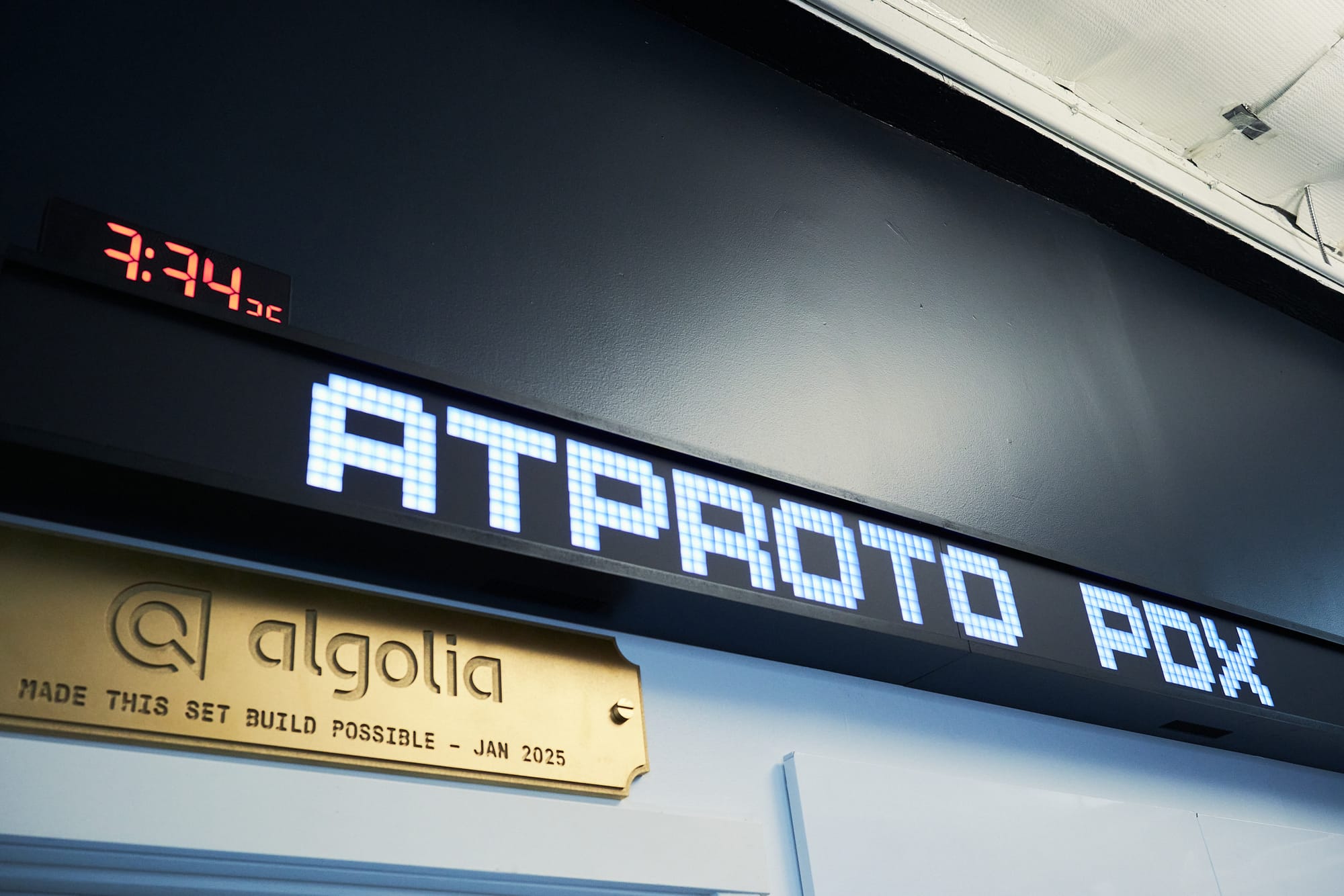
I don't mean that as a bit. I mean the specific feeling of a room full of people who believe, quietly, without hype, that the thing they're working on could matter. The early web had rooms like this. A few nerds, some folding chairs, a shared sense that the giants weren't inevitable. That's what Tuesday felt like.
What atproto actually is
For the non-nerds: the AT Protocol — atproto, for short — is a set of open rules for how social apps can talk to each other. Think of it less like a website and more like email. Nobody owns email. Gmail and Outlook are just two apps that agree on the same plumbing, which is why a Gmail user can send a message to an Outlook user without thinking about it.
Atproto wants to do that for social software. Your identity, your posts, your follows; they live in a place you control, and any app built on the protocol can read and write to that place with your permission. If you don't like the app you're using, you move. Your followers come with you. Your posts come with you. The app loses you; you lose nothing.
That is a very different arrangement from the one Facebook, X, and Google have trained us to accept.
A short history
Atproto started inside Twitter. In late 2019, Jack Dorsey funded a small research team called Bluesky to study decentralized social protocols — partly, the story goes, because he'd concluded Twitter shouldn't be the one deciding what speech lives and dies on the internet. In 2021 Bluesky spun out as an independent public benefit corporation. In 2022 they published the first version of the protocol. In early 2024 the flagship app, Bluesky, opened to the public. By 2026 the network crossed forty million users and a couple billion posts, and — critically — the data is open. Anyone can build on it.
That last part is where the room comes in.
The things people are actually building
Bluesky (bsky.app) is the one most people have heard of: short-form posts, follows, the familiar shape of a timeline. But it's just one app on the protocol, not the whole protocol.
A few others worth knowing:
- Blacksky — a Black-culture-centered social space built on atproto, independent from Bluesky the company. Same underlying network, different community, different moderation, different priorities. This is the portable-followers promise made real.
- Grain — photo sharing on atproto. A small team rebuilding what early Flickr felt like, without the enshittification arc baked in.
- Germ Network — end-to-end encrypted messaging on atproto. Private conversation as a first-class citizen of the open network.
Four apps, one underlying substrate, no permission needed from any of them to build the fifth.
The room
Jason Lengstorf hosted; he gave over his Code TV studio for the night, which is the kind of gesture that makes a scene exist.
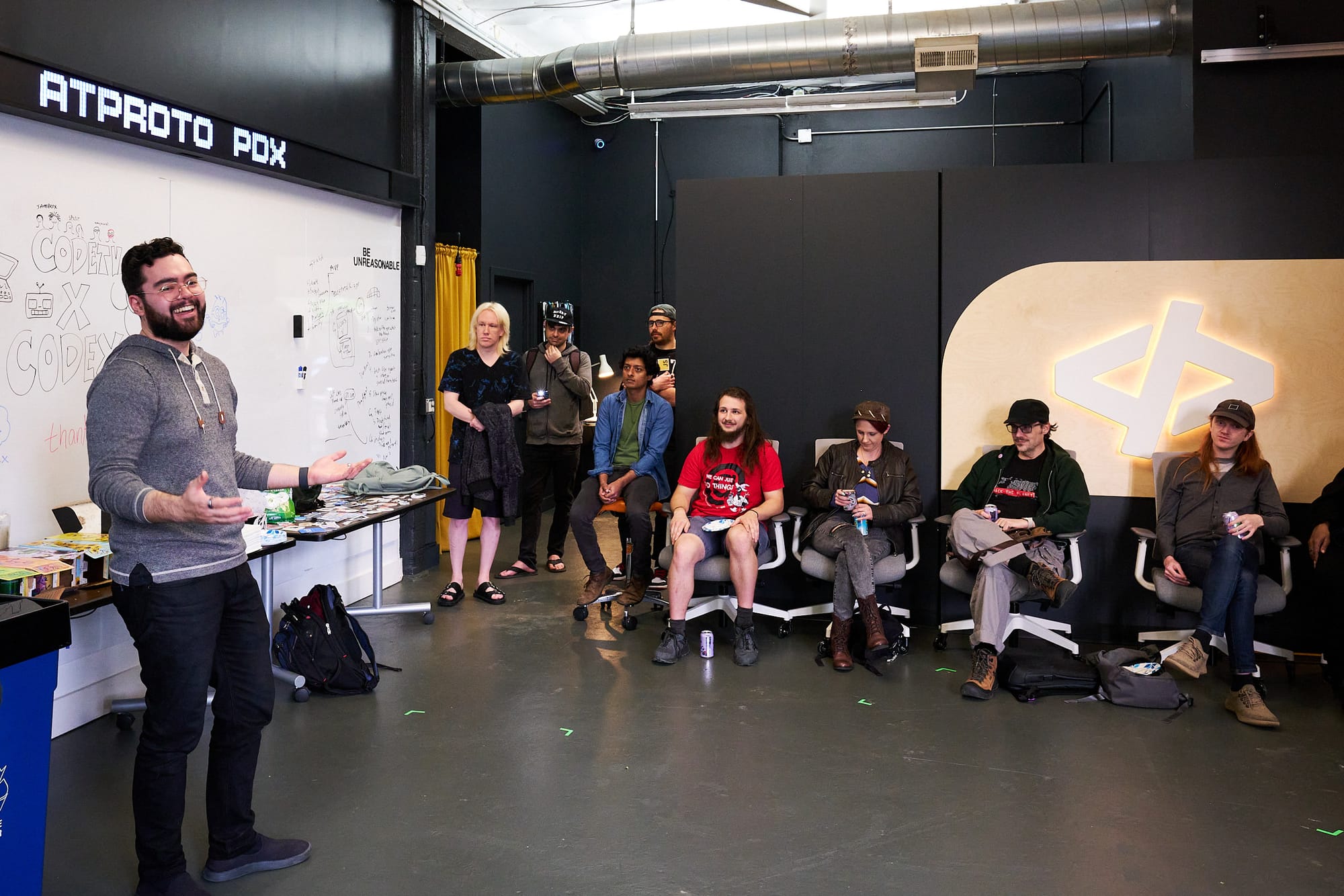
Graham and Kat ran the meeting itself, and the format was the best part. Instead of a single front-of-room presentation, they broke the thirty-ish of us into small groups, each one seeded with at least one person who is already actively building on atproto. The rest of us were newcomers: curious, confused, somewhere in between - and the job of the group was simply to talk. Ask anything. How does an account actually work? What's a PDS? What stops someone from impersonating me? What can I build this weekend?
It's a deceptively generous way to run a meetup. No one has to be an expert in the whole room. The builders get to meet the people who'll use the things they're making. The newcomers get to ask the dumb question to one person instead of thirty. And the energy doesn't come from a stage - it comes from six small conversations happening at once, which is what a scene sounds like when it's working.
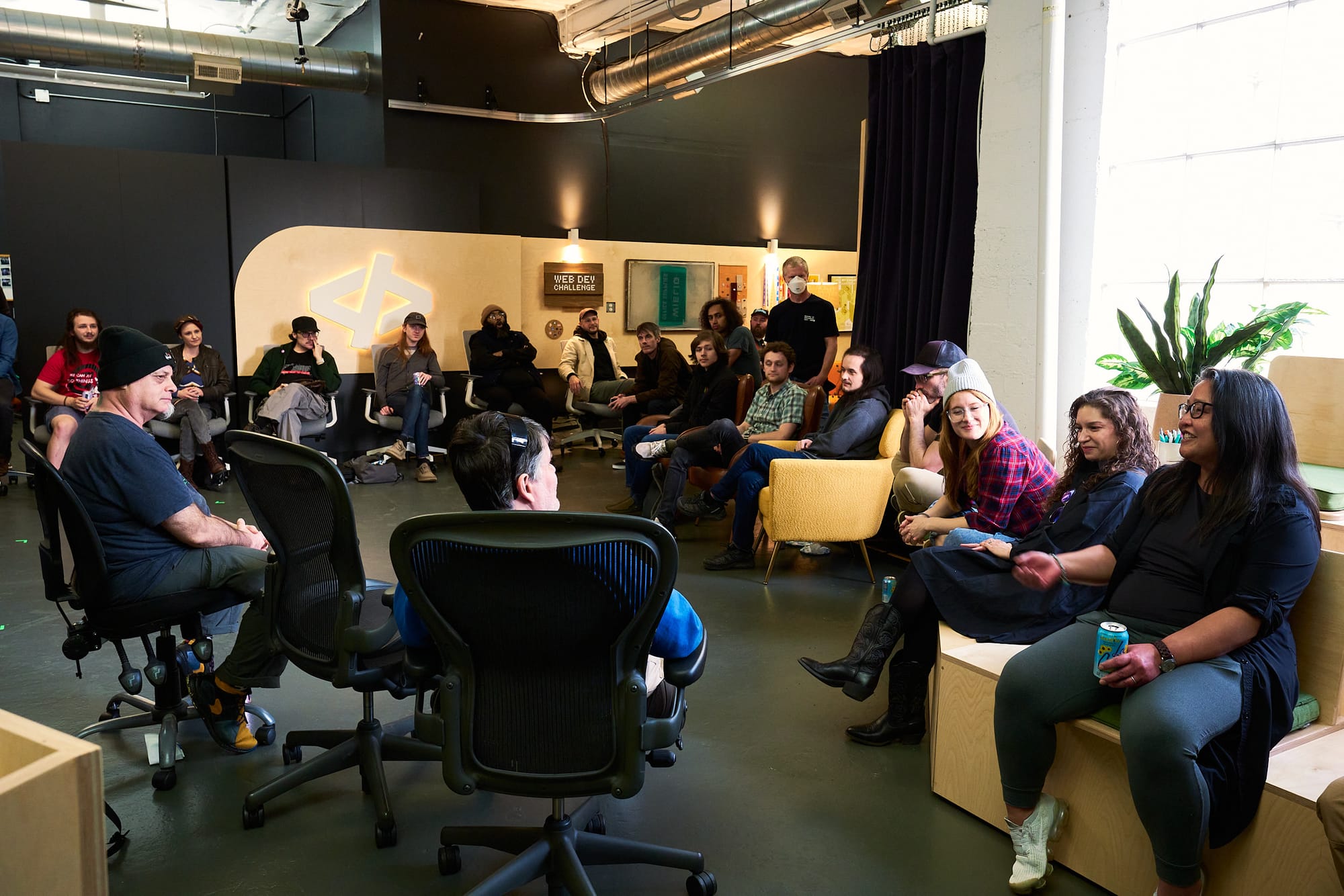
I took some photographs. But mostly I just listened, because the conversation was the thing.
Why it matters
The open web of the nineties didn't win because the tools were better. It won because a critical mass of people decided that the alternative, a handful of AOL-style walled gardens choosing what everyone saw, was not the future they wanted. Then they built their way out of it. Slowly, unglamorously, in rooms that looked a lot like this one.
Whether atproto ends up being the thing, or a stepping stone to the thing, I don't know. Nobody in the room claimed to know. But the work is real, the apps are shipping, and the people building them are taking it seriously without taking themselves seriously. That combination is rare, and historically, it's the one that wins.
Monthly meetings, first Tuesdays. I'll be back in May.
Thanks to Jason for the studio and the hospitality, and to Graham and Kat for running the kind of meeting where nobody has to perform expertise to the whole room.